AWS and DuckDB: a Wild West Story
On August 26, DuckDB announced that DuckLabs is joining AWS as a new subsidiary. It is big news in the data world. The internet is already preparing the funeral, although "AWS bought DuckDB" is not quite correct.
DuckDB is the open-source database. DuckLabs is the Amsterdam company that employs many of the main DuckDB contributors. The DuckDB Foundation owns the core intellectual property. According to the announcement, DuckDB, DuckLake, Quack and the extensions will remain open source under the MIT license.
So, should we worry? Of course we should. We are engineers. I have three theories.
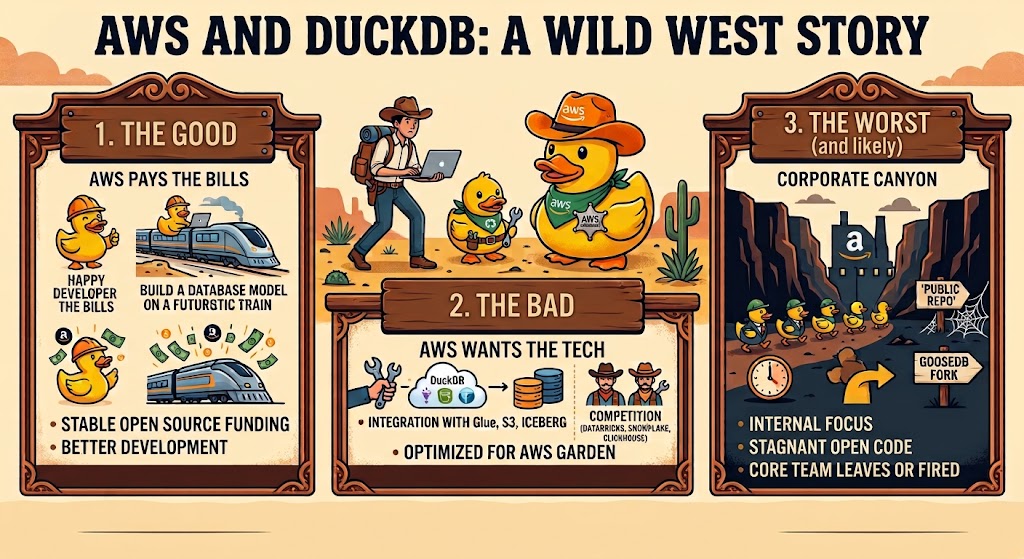
1. The good theory: AWS will pay the bills
DuckDB is used everywhere: on laptops, in notebooks, CI pipelines and data products. It is small, fast and can read formats like Parquet and Iceberg. But maintaining a project like this is not free. You need engineers, testing, releases and support.
With AWS money, the DuckDB team may be able to spend more time building the database and less time finding funding or doing consulting work. That could be very good for us. We get a better-funded open-source project, and AWS pays the bill. Finally, someone else is buying the coffee.
The Foundation and the MIT license also offer some protection. AWS cannot simply take the existing code and make it private tomorrow. At least not without making the lawyers and the internet very busy.
2. The practical theory: AWS wants the technology
AWS has many data services, but the competition is strong. Databricks, Snowflake, ClickHouse, Trino and others are moving fast. AWS also has a lot of services, so adding one more to the menu should be easy, right?
DuckDB is interesting for AWS because it is not another cloud warehouse. It can run inside an application, on a laptop or close to the data. The DuckLabs team's experience could help AWS with local analytics, Glue, S3, Iceberg and other data services.
This could be useful. Better integration with AWS is not automatically bad. The problem starts if DuckDB becomes much better inside AWS than everywhere else. The community needs a tool that works well across clouds, not only in one AWS garden. Otherwise the duck may become free, but only after accepting 37 IAM permissions.
3. The bad theory: the corporate machine
The biggest risk is not that AWS closes DuckDB. The MIT license protects the existing code. The real risk is that the core engineers slowly stop working on the public project and focus on internal AWS priorities.
The code can remain open source and still become less useful. Releases can slow down. Important extensions can focus on AWS. The project can become less friendly to people on other clouds. And some engineers could leave to start a new database called GooseDB.
This is why the next few months matter more than the announcement. I will watch the release pace, GitHub activity, support for non-AWS environments and what the DuckDB Foundation actually does. Also, how many times AWS says "customer-centric" in the next press release.
What should we do?
For now, nothing dramatic. Keep using DuckDB if it works for you. It is still a great option for local development, homelabs, CI/CD and analytics workloads. No need to migrate everything to Spark just because a slide deck said "synergy".
But keep your architecture portable:
- Store data in open formats like Parquet or Apache Iceberg.
- Keep transformation logic separate from the database engine.
- Pin DuckDB versions in CI and test upgrades.
- Do not depend too much on new AWS-only features before we know how portable they are. "Portable" should mean more than "works in three AWS regions".
If things go wrong, we should be able to change the compute engine without moving all our data and rewriting everything.
My thoughts
I do not think this is a reason to panic. It can give DuckDB more money and more engineers. It can also bring more AWS influence into the project. Both can be true. The cloud can fund the duck and still try to sell us a duck-shaped subscription later.
The best plan is simple: keep using DuckDB, avoid unnecessary lock-in and watch the real work instead of guessing from headlines. Keep a backup plan, because "we can migrate later" is the most popular bedtime story in data engineering.
For now, the more accurate headline is:
DuckLabs is joining AWS. DuckDB is still open source, and the interesting part is what happens next.