The Open Source Trojan Horse
For the last decade, the Silicon Valley infrastructure playbook was very predictable: launch a project under a permissive open-source license, ride the community goodwill to reach market dominance, and raise hundreds of millions in venture capital.
Then reality arrives. Revenue targets get closer, the big cloud providers repackage the tool as a managed service, and the corporate sponsor panics and pulls the rug: the permissive open-source license is swapped for a restrictive, proprietary one.
The bait-and-switch problem
To be clear: building closed-source or source-available software is not bad by itself. Companies have every right to build a profitable business and protect their intellectual property.
Projects like n8n (Fair-code / Sustainable Use License) or Redpanda (Business Source License for the enterprise features) set clear commercial guardrails early in their life. When a company declares its business intentions from day one, developers can make an informed choice about adopting the technology. The expectations are honest and the trust stays intact.
The toxicity starts with the bait-and-switch. The betrayal is when a company uses the open-source wind to become ubiquitous, benefiting from thousands of unpaid community bug reports, third-party integrations and grassroots evangelism, and then locks the gates once it is an industry standard. It is using a community to build your empire, and then punishing that same community for your own failure to build a defensible business model.
A history of fractured communities
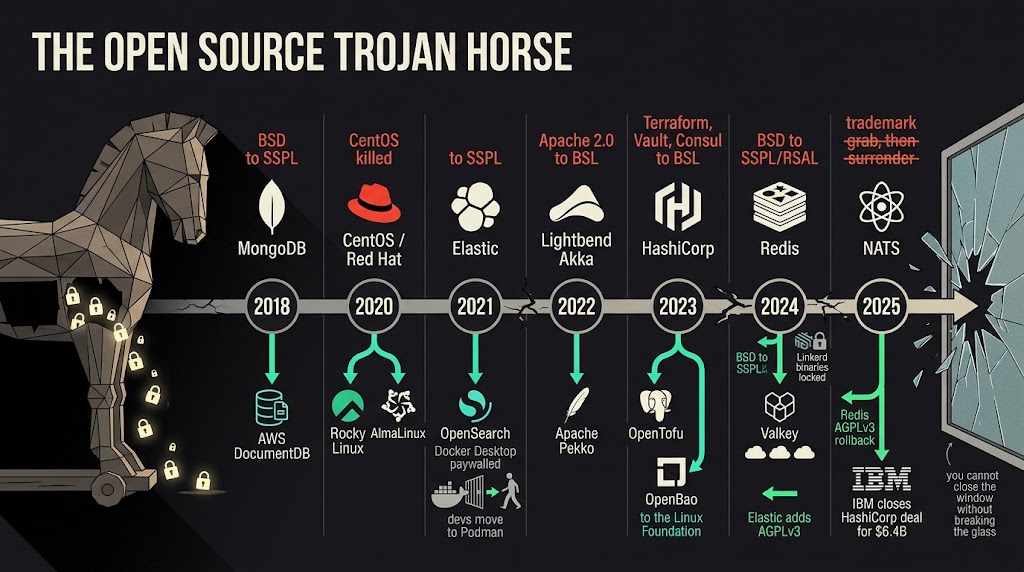
When companies change the rules of the game in the middle of the game, it almost always starts an ecosystem war. * 2018, MongoDB's SSPL salvo. MongoDB drops its open-source license for the new Server Side Public License (SSPL), to force cloud providers to open source their underlying management infrastructure. AWS answers with DocumentDB, a proprietary clone. * 2020, the death of CentOS Linux. Red Hat (IBM) abruptly terminates CentOS as a stable downstream clone of Red Hat Enterprise Linux (RHEL). The community forks it immediately, and Rocky Linux and AlmaLinux are born to fill the void. * 2021, the cloud wars escalate. Elastic moves Elasticsearch to the SSPL to fight AWS. AWS forks the code into OpenSearch and the ecosystem splits. At the same time, Docker puts Docker Desktop behind a paywall for large companies, and many developers move to alternatives like Podman. * 2022, Lightbend locks down Akka. Lightbend abandons Apache 2.0 for the Business Source License (BSL) in the very popular Akka framework. The Apache Software Foundation hosts the community fork, Apache Pekko. * 2023, the infrastructure shock. HashiCorp moves its entire suite (Terraform, Vault, Consul) to BSL. The infrastructure community revolts, and a coalition of vendors forks the code into OpenTofu (Terraform) and OpenBao (Vault), both handed to the Linux Foundation for neutral stewardship. * 2024, the cache crisis and the binary paywalls. Redis abandons its BSD license for a dual SSPL/RSALv2 model, and the Linux Foundation's Valkey fork appears almost immediately, backed by AWS, Google and Oracle. Elastic goes in the other direction and adds an AGPLv3 option to Elasticsearch. Separately, Buoyant keeps the Linkerd code in the CNCF but puts the stable binaries behind a paywall. * 2025, the NATS standoff and the great rollback. Synadia tries to pull NATS out of the CNCF using a trademark loophole, and surrenders after a lot of pushback. Redis, watching how many enterprises had already moved to Valkey, reverses course and adds the OSI-approved AGPLv3 option. IBM closes the HashiCorp acquisition for $6.4B and keeps the BSL, while OpenTofu keeps growing.
The end of the single-vendor monopoly
The era of the single-vendor open-source monopoly is dead. Today, when a company tries a rug pull on a foundational tool, the ecosystem does not only complain, it mobilizes. Cloud providers, competitors and burned developers fund foundation-backed forks and move the engineering talent away from the original creator.
If a company wants to build proprietary software, it should do it from the start. But if it decides to ride the open-source wind to the top, it is learning the hard way that it cannot suddenly close the window without breaking the glass.